
Why a Soil Treatment Project Ignoring the KOC Value is a Guaranteed Fiasco of Blind Gambling?
In the Malaysian pest control industry, many professionals fall into a fatal trap: "I’ll just use whatever brand has the biggest name." The result? Just a year or two after project completion, termites return, clients complain, and company reputations are ruined.
Today, MIC (Modern Innovative Chemical) tears away the veil of commercial advertising. Using pure chemical and physical data, we reveal the ultimate secret that dictates the life or death of your termite barrier: Koc Value (Organic Carbon Adsorption Coefficient).
🧬 What is Koc Value? Why is it the "Lifespan Lock" for Termiticide?
Simply put, Koc value measures a chemical's binding power to the organic carbon in soil particles.
High Koc Value: The chemical forms an unbreakable bond with the soil. Even under torrential monsoon rains or active groundwater movement, the formulation will not detach, stubbornly guarding the soil to provide extremely long-lasting efficacy.
Low Koc Value: The chemical has virtually zero binding power to the soil. As soon as it rains, the formulation detaches, dilutes, and washes away with water, causing the entire barrier to collapse.
Malaysia is notorious for heavy downpours and high water tables. Applying a product with the wrong Koc Value into the soil means you aren't spraying protection—you are spraying an illusion that will wash away with the next rain.
🥊 The Ultimate Showdown: Zefenthrin VS Zetdor (Data Never Lies)
To uncover the truth, let’s place the market's two most prominent chemical schools of thought under the spotlight:
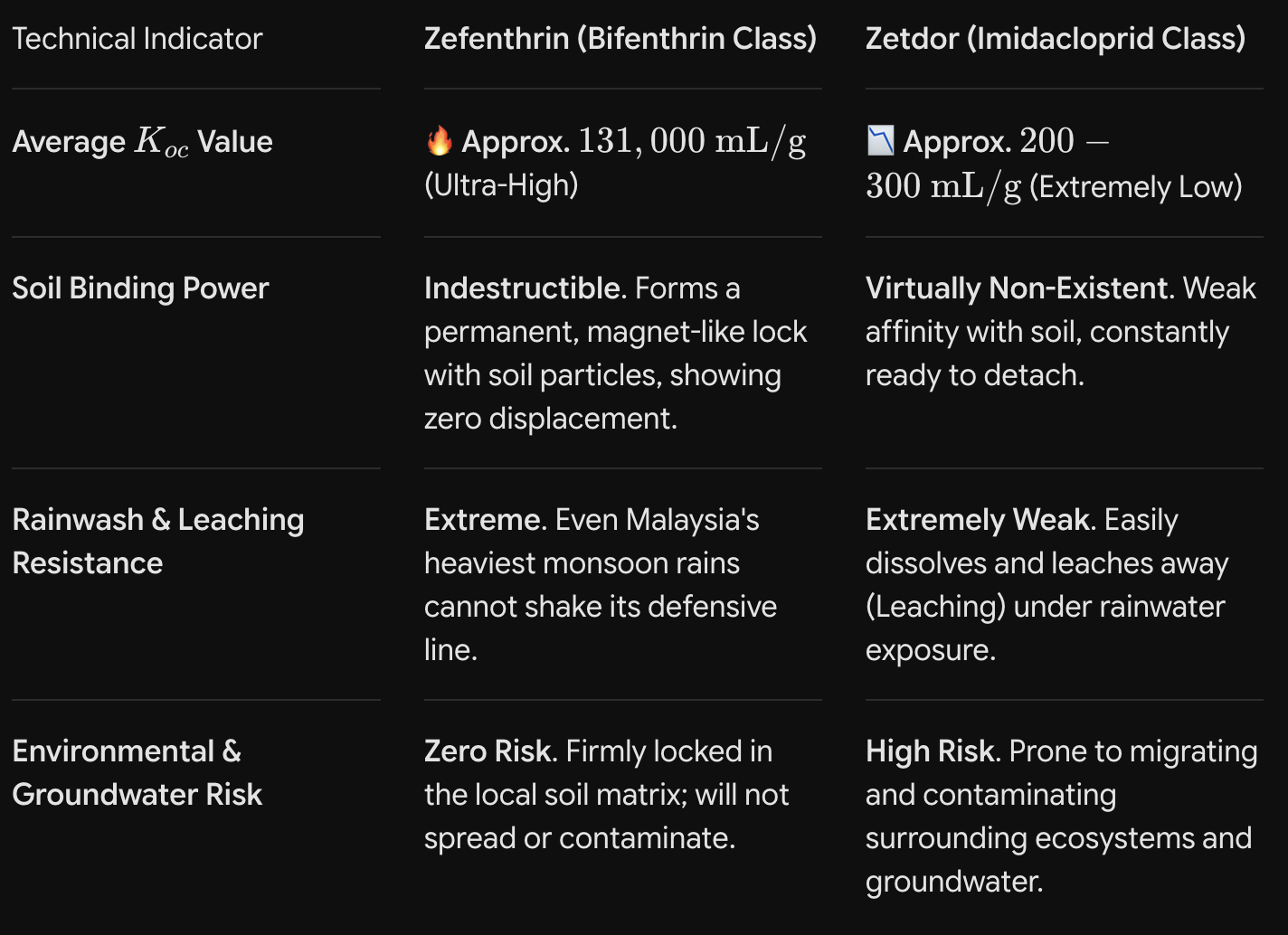
👑 Zefenthrin: The Soil's "Absolute Lock"
Statistically, Zefenthrin boasts a staggering KOC value of 131,000! What does this mean? When sprayed during pre-construction ground excavation to establish a termite barrier, it binds permanently to the soil's organic matter within 0.1 seconds. No matter how heavy the rain or how volatile the groundwater table in Malaysia, it remains insoluble and unmovable. It stays exactly where it was applied, forming a permanent eradication zone that lasts for years, even a decade.
⚠️ Zetdor: The "Water-Soluble Trap" of Blind Followership
Many PCOs blindly follow products like Zetdor (Imidacloprid), captivated solely by its laboratory knock-down speed. However, they completely overlook its pathetic KOC value of just 200 - 300 and its relatively high water solubility. In Malaysia’s hot and humid climate with frequent rain, the soil simply cannot retain it. After just a few rainy seasons, the active concentration drops off a cliff. This is the root cause of why many job sites suffer severe termite breakouts just two years post-treatment!
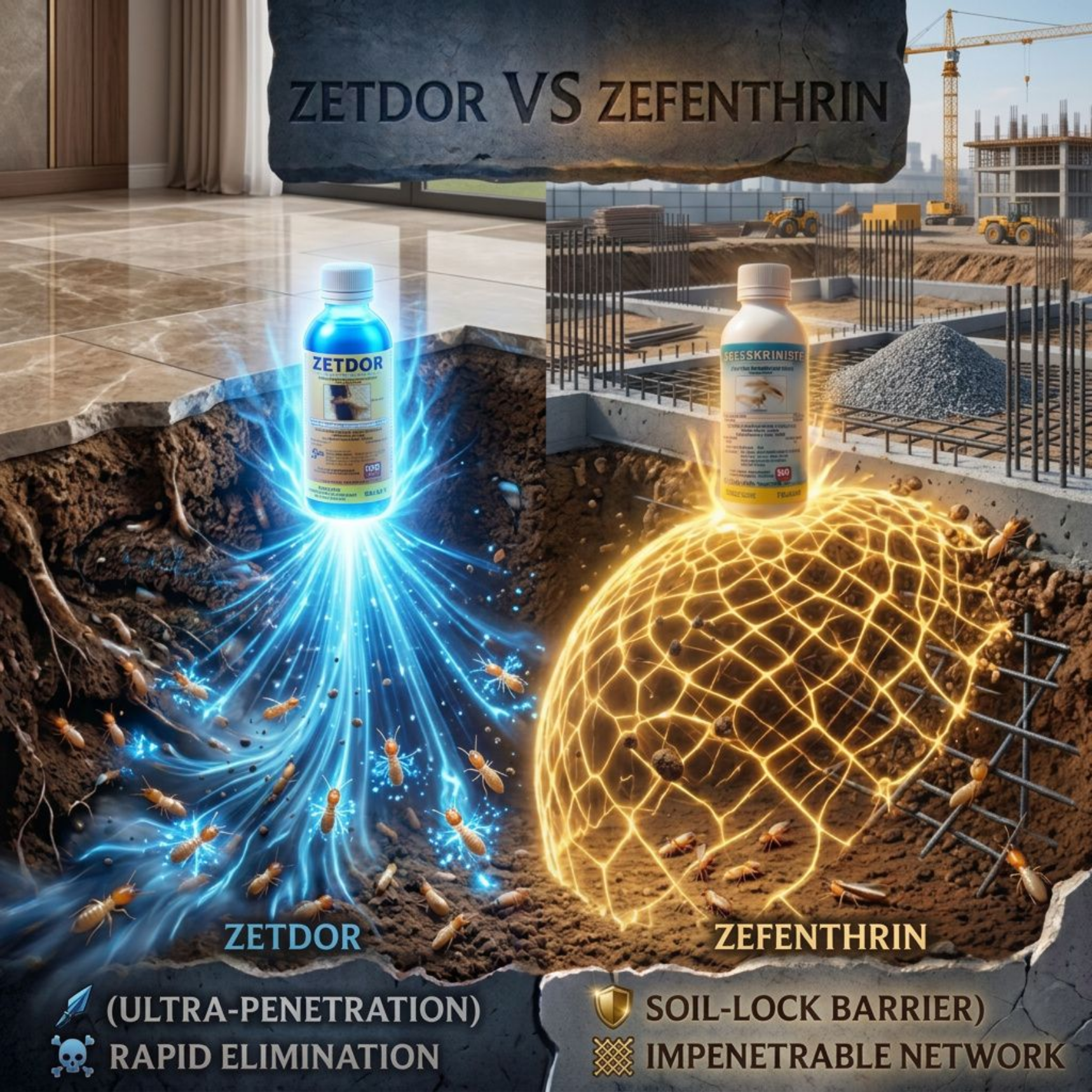
In the arena of Malaysian pre- and post-construction anti-termite soil barrier treatments, "brand recognition" and "laboratory knockdown speeds" have been historically overhyped. Meanwhile, the absolute linchpin governing the success or failure of the entire protective barrier—soil micro-environmental interface and physicochemical dynamics—has been profoundly neglected by the industry.
While many in the industry recognize that the KOC value represents the organic carbon adsorption coefficient, the vast majority remain completely blind to how this microscopic integer directly dictates the geometric integrity, lateral diffusion breadth, and ultimate degradation kinetics of the chemical termite barrier.
Today, MIC (Modern Innovative Chemical) tears down the industry veil from the advanced perspectives of environmental toxicology and interfacial chemistry, completely dissecting the fundamental physical and molecular logic of why the KOC value acts as the immovable anchor for termiticide longevity.
1. Microscopic Soil Architecture: Why Low-KOC Formulations Categorically Fail to Establish a "Geometrically Continuous Physical Barrier"
The ultimate goal of any anti-termite soil treatment is to weave an unbroken, flawless chemical carpet across the building's foundational soil matrix. However, at a microscopic level, soil is far from a solid block; it is an immensely loose, porous grid consisting of sand particles, clay, and Soil Organic Matter (SOM / Organic Carbon).
When a chemical formulation is injected into the soil, its molecules face one of two fates: they are either firmly adsorbed onto the organic carbon surfaces of soil particles, or they remain suspended within the Soil Pore Water (the moisture filling the empty cavities between soil grains).
The Microscopic Catastrophe of Zetdor (Imidacloprid Class / Koc approx 200 - 300 mL/g ):
With a critically low Koc rating, this formulation possesses an incredibly weak affinity for the organic carbon matrix of the soil. Upon application, the vast majority of its active molecules remain free-floating in the soil pore water.
Malaysia is plagued by a tropical rainforest climate characterized by extreme humidity and intense monsoon downpours. As torrential rains penetrate the earth to form rapid underground hydraulic currents, the suspended Zetdor molecules undergo severe downward vertical leaching and lateral displacement. Within weeks, this once-uniform chemical carpet develops countless "chemical gaps." Termites are relentless, blind physical excavators; the moment a chemical barrier cracks by a single millimeter, they will breach the gap and infiltrate the building structure.
The Microscopic Lock-in of Zefenthrin (Bifenthrin Class / Koc approx 131,000 mL/g ):
Boasting a staggering six-figure KOC value , Zefenthrin possesses a fearsome, highly specific chemisorption affinity for soil organic carbon. The exact millisecond a molecule contacts the soil, it physically locks onto the surface of the soil particle via intense Van der Waals forces and hydrophobic interactions, acting like a molecular magnet.
Because over 99% of the active ingredient is rigidly anchored to the soil matrix, its solubility in the soil's liquid phase drops effectively to zero. Even if Malaysia suffers a century-level severe flood or aggressive groundwater surges, the Zefenthrin molecules remain entirely immovable, preserving a continuous, immutable, and flawless geometric shield.
2. Molecular Conformation Disparity: Why High KOC Grants Zefenthrin the Ultimate "Asymmetric Lethality Advantage"
In terms of eradication mechanisms, many PCO companies blindly trail behind products like Zetdor due to its heavily marketed "non-repellent colony elimination" concept, hoping workers carry the toxin back to wipe out the queen. While this is an exquisite laboratory theory, it encounters devastating chemical variables in Malaysia’s raw outdoor environment.
The Molecular Vulnerability of Zetdor:
Imidacloprid belongs to the neonicotinoid class. Its molecular structure contains highly polar nitro groups and pyridine rings, making it intrinsically water-soluble. Within the high-temperature, high-humidity subterranean environment, the combination of a low KOC and high water solubility subjects the molecule to rapid microbial degradation and chemical hydrolysis. Its active concentration suffers an exponential decay. You applied it expecting long-term colony transfer, but the harsh reality is that before the termites even arrive, the environment has already diluted the chemical below sub-lethal concentrations, inadvertently rendering it an "immunity training camp" for the pest.
The Structural Supremacy of Zefenthrin:
Bifenthrin features a unique molecular structure composed of a highly hydrophobic biphenyl ring paired with a fluorinated pyrethroid core. This heavily non-polar spatial conformation not only secures its ultra-high Koc property but completely locks out water solubility (making it practically insoluble). Because it cannot dissolve in water, it is entirely shielded from the aggressive alkaline and acidic hydrolysis found in tropical soils, yielding an extraordinarily long chemical half-life. As termites attempt to burrow through the barrier, they collide with soil particles locked in with Zefenthrin. Its intense contact neurotoxicity immediately blocks the pest's sodium channels on the spot, achieving total, localized, absolute eradication.
3. Environmental Toxicology Audits: Why High Koc is the "Only Golden Ticket" to Pass Strict MNC Corporate Governance
Modern multinational manufacturing giants (such as Nestlé or Unilever) and high-precision semiconductor firms (such as Intel) enforce environmental compliance and groundwater safety audits in Malaysia that are borderline draconian.
If a PCO contractor blindly relies on a low-Koc ingredient like Zetdor beneath the foundations of these mega-facilities:
The moment the multinational's EHS (Environmental Health and Safety) auditors review the chemical's technical data sheet and see a Koc value of merely two to three hundred, an immediate red flag will be raised. A low Koc value translates directly to aggressive environmental migration, exposing the corporation to catastrophic legal and operational risks of chemical leaching into surrounding aquifers or infiltrating the facility's vast subterranean utility networks. If trace residues are detected in the facility's water loops, the PCO entity faces astronomical liabilities.
Conversely, the moment you submit the technical whitepaper for Zefenthrin Koc approx 131,000):
The auditors will grant immediate clearance. In international environmental toxicology, a six-figure KOC value represents an absolute non-leachable status (zero groundwater mobility). The molecule stays precisely where it was injected forever. It cannot and will not migrate into any passing groundwater stream. This is no longer just structural pest control; it is the ultimate insurance policy for a multinational corporation's compliance threshold.
🏛️ MIC Commercial Clarity: Science is the Sole Weapon to Terminate Destructive Price Wars
In the low-tier pest control market, blind followership and information asymmetry reign supreme. While regular contractors allow themselves to be brainwashed by flashy consumer advertising—slashing prices by pennies to survive brutal e-commerce price traps—MIC (Modern Innovative Chemical) chooses to arm Malaysia's elite PCO pros with raw, unassailable scientific data.
Understanding the physics of the KOC value shifts your identity from a basic spray technician to a structural protection expert specializing in interfacial chemistry.
Abandon the low-Koc, rain-fleeing formulations of the masses. By executing with Zefenthrin—the master of six-figure soil immobilization—you can confidently guarantee your industrial clients an ironclad, decade-long structural defense.